
Why Did The NS Savannah Fail? Can She Really be Called a Failure?
(Post was originally published on July 1, 1995. It was updated on April 2, 2011 to include information and videos that were not available in when it was first written. The title has also been revised to open up a new discussion – was the NS Savannah a failure or a successful demonstration of a technology whose time has not quite arrived?)
On Friday, March 23, 1962, the N.S. Savannah became the first nuclear merchant ship at sea. In 1972, after ten years of demonstrations and operations, she was laid up in an effort to reduce spending by the Maritime Administration.
In the lore of the nuclear industry, her early retirement proved that nuclear power was not a viable option for commercial shipping. Once again, Atomic Insights will discuss why we believe that the conventional wisdom is wrong.
Savannah’s Planned Mission
Most people who are aware of the experiment do not understand what the N.S. Savannah was designed to do. Her planned mission was to prove to the world that the United States was committed to the proposition of using atomic power for peace and to show that a nuclear reactor could be used to power a commercial ship. She was never intended to be profitable. The details of Savannah’s design and operational history offer some valuable lessons for future nuclear ship programs.
Update: (Added April 2, 2011) In the second of the news clips in the below video, you will hear the specific statement made that the ship was never intended to be an economic commercial proposition. Even when the ship was being launched, American taxpayers were informed that she was conceived and built to be a pioneer. At that time, people were comfortable with the idea that governments sometimes invest in new ideas and new demonstrations of technology. End Update:
By technical measures, the ship was a success. She performed well at sea, her safety record was impressive, her fuel economy was unsurpassed and her gleaming white paint was never smudged by exhaust smoke.
A Lady at Sea
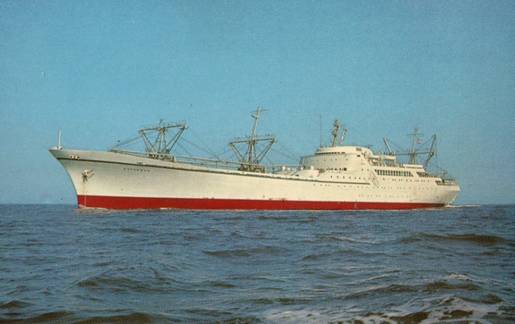
Savannah was visually impressive. Her hull was streamlined, looking more like a luxury yacht than a bulk cargo vessel. Even her cargo handling equipment was designed to look good. Maritime historians often comment that she was “the prettiest merchant ship ever built.”
Her interior was also not typical of bulk freighters; she was endowed with 30 air conditioned staterooms, each with an individual bath, a dining facility that could seat 100 passengers, a lounge that could double as a movie theater, a veranda, a swimming pool and a well stocked library.
She was a fast ship with incredible range. With her 20,000 horsepower nuclear engine her top speed was 23 knots. Savannah was capable of circling the earth 14 times at 20 knots without refueling.
Savannah was not well endowed with cargo space. Her holds could accommodate just 8,500 tons of freight in a total space of 652,000 cubic feet. Many of her competitors were able to transport several times as much cargo. Her streamlined hull made loading the forward holds a labor intensive proposition, which became a significant disadvantage as ports became more and more automated.
Her crew was larger than comparable oil powered ships (67 compared to about 50). Her budget included the maintenance of a separate shore organization for negotiating her port visits and a personalized shipyard facility for completing any needed repairs.
The crew was trained in special schools after completing all training requirements for conventional maritime licenses. The number of people sent through the training and attributed to the Savannah’s books indicates a plan for the eventual construction of additional nuclear steam ships.
Anyone familiar with the bulk shipping market could immediately recognize that a ship with Savannah’s characteristics could not be a commercial proposition. Her passenger space was wasted while her cargo capacity was insufficient.
Having a unique propulsion plant increased the cost of repairs and spare parts relative to machines with a larger installed base of customers. The large crew of hand-picked people added even more costs. Expecting her to make money as a bulk freighter was like expecting an auto show concept car to make money as a jitney taxi.
Condemned to a Short Life
In the words of Robert J. Bosnak, a former officer in charge of the Marine Inspection team that regulated the Savannah, “The Savannah performed well from an operational point of view, but in my opinion her designers condemned her to a short life by her hybrid design as a passenger-cargo vessel. Neither function of the ship proved to be economically viable, and MARAD (Maritime Administration) chose not to spend additional monies to convert her to an all cargo, or an all passenger vessel, but instead removed her from service. I regret that this happened.”
As a result of her design handicaps, Savannah consumed approximately $2 million more per year in operating subsidies during her four year career in international trade than a similarly sized Mariner class ship with an oil heated steam plant. This extra subsidy became a target for economy-minded legislators.
In 1972, when Savannah was laid up, the cost of a ton of oil was about $20.00. A ship with a 20,000 horsepower engine using 1970s technology would have burned about 120 tons per day for a daily fuel cost of about $2,400. By early 1974, following the Arab Oil Embargo, a ton of bunker fuel cost about $80.00. That same ship’s daily fuel bill would have suddenly increased to more than $9,000. Savannah’s fuel cost would not have changed as a result of the Oil Embargo. If the oil-burning ship operated for 330 days per year (which is common in the world of merchant shipping), the increase in its annual fuel expenditure would have more than eliminated the difference in Savannah’s operating costs, even with all of her inherent disadvantages.
Update posted on March 31, 2009: The N/S SAVANNAH ASSOCIATES, INC. has just posted a beautiful web site with historical details about the ship, her history and the current effort to recondition and protect her. If you are interested in learning more or in signing up for a mailing list of people interested in the ship, visit www.nssavannah.net.
Update posted on August 16, 2009: If you are interested in keeping up with the Maritime Administration’s (MARAD) plans for decommissioning, preserving, and displaying the NS Savannah, here is the site for you. U. S. Maritime Administration Virtual Office of Acquisition – NS SAVANNAH website
Update posted on April 2, 2011 I found this interesting trailer, but have not yet determined if the advertised video project was ever completed. If you know anything about this project, please share the information with the rest of us.
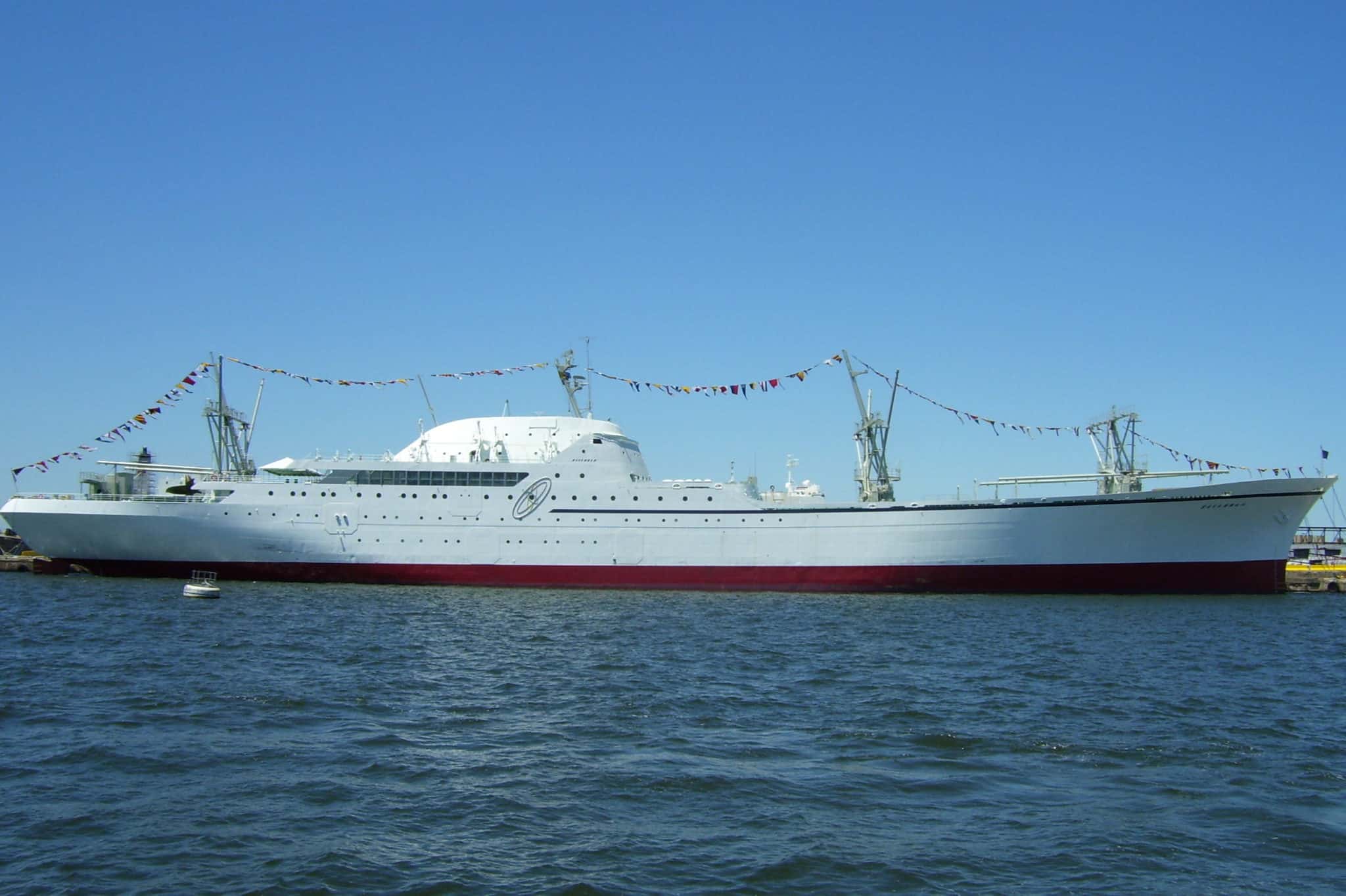
An acquaintance took this photo of NS Savannah during the 50th anniversary in the summer of 2009. The ship remains docked in Baltimore where it is occasionally possible to arrange tours with the Maritime Administration people who are in charge of keeping her in a SAFESTOR condition. If you are interested in making contact with the right people, please let me know; I do not want to set my contacts up for spam email by publishing their address here.
PS – just in case you were wondering why I chose to republish this historical post in April 2011, I suppose it is because I have been thinking a lot recently about convincing people that nuclear energy can make a difference in oil consumption. By increasing the supply of energy available to perform tasks that are currently done by burning oil, it is possible to shift the supply/demand balance back in favor of consumers to drive down the price paid to producers.
If you think that energy should be expensive to encourage conservation, perhaps we should think about adding taxes to it; at least that way, the increased revenues from the excessively high prices do not mainly benefit Saudi princes, multinational investors or Russian oligarchs.
Update April 2, 2011 4:45 pm I found one more video that might be of interest. Someone apparently converted an old 16mm film taken on board the NS Savannah while underway in 1964 into a clip to share on YouTube. I recommend watching with your speakers muted – the 16 mm film machinery noise is a bit irritating.


That’s a great looking ship. Maybe it wasn’t a commercial success but it was a great showcase for the possibilities.
Any thoughts on why the Savannah ended up being an only-of-its-kind ship instead of the first-of-its-kind that it was intended to be?
That is, presumably this was supposed to be the first ship of many, and the U.S. was intending to launch a commercial nuclear shipping industry. Any idea why that failed to happen?
@Jeff S – there are many reasons why the NS Savannah did not lead to an immediate effort to build a fleet of nuclear powered commercial vessels. I produced an abbreviated summary of the reasons back in the mid 1990s when I was trying to convince commercial shippers to give the technology another try. http://www.atomicengines.com/ships.html.
I have recently detected a growing interest in the topic as fuel costs increase and as regulations that govern pollution from sulfur dioxide get ever more challenging. Up until just a year or so ago, ships were one of the few remaining markets for high sulfur residual oil – aka bunker C. That fuel was far cheaper than the low sulfur distillates that ships are now required to burn almost all of the time, but it was also found to be damaging the global environment.
As recent, widely reported radiation detections have shown, stuff that gets airborne can often be distributed all around the world via the jet stream. It should be pretty logical to recognize that if Xe-133 or I-131 can be found in the US and sourced to an event in Japan, that acid rain in Europe or America can result from sulfur dioxide pumped into the atmosphere from a ship at sea.
@Rod,
I noticed on the page you linked to, that you have a comment that “At current prices, reactor fuel costs 85 percent less than bunker fuel.”
I’d like to ask for a clarification – what are you comparing, price by weight (pound/ton/tonne), or price by energy (watt/horsepower)?
In either case, 85% is a great discount, but if it’s pound-for-pound 85% cheaper, that ends up being a huge, huge difference since each pound of fuel gives, what, hundreds of thousands or a million times more energy? But, I suspect that 85% figure already reflects the math of calculating the energy difference?
@Jeff – the price comparison is on a per unit energy basis. It is probably time to do a new calculation using more up to date cost numbers for both commercial nuclear fuel and distillate fuel oil.
The NS Savannah as you pointed out, was a technology demonstrator, but the bottom line is that it was just too soon. Unfortunately, now that the time has come, she will be held up as a failure by antinuclear forces, which is a shame.
Bunker fuel is about the nastiest fuel imaginable. Ports around the world are tightening their emissions standards. Shipping companies have to respond. They may install expensive filters. They may in the future have ships that run on CNG. But this all sounds more complicated and expensive than building a nuclear ship.
Rod, I am sure you know this: the Germans built a nuclear ship, the Otto Hahn.
http://en.wikipedia.org/wiki/Otto_Hahn_(ship)
I actually saw this ship when I was a kid in 1977, that time in the harbour of Hamburg.
Savannah was not designed with cargo carrying economic parameters in mind. She demonstrated that nuclear propulsion in a semi-military environment was possible and safe. [Subs had already shown that full-military operation of nuclear propulsion was both safe and naval-operations reliable.]
Government frequently authorizes work-start and fully expresses design requirements much later.
A publicity-oriented project such as nuclear propulsion had its own goals and imperatives; economic cargo-operation was obviously not one of Eisenhower’s prime concerns.
This wall chart of the NS Savannah would go well here.
http://econtent.unm.edu/cgi-bin/showfile.exe?CISOROOT=/nuceng&CISOPTR=30&filename=39.pdf
And this discussion of residual fuel consumption is semi-related, but would probably be better suited as an illustration of Rod’s point that the first nuclear power plant build out essentially pushed oil out of the electricity generation fuel market, other than its remaining ~2% share.
http://www.eia.gov/todayinenergy/detail.cfm?id=4250
nuclear ship is bad idea. what if ship sink at sea? nuclear material at the bottom of ocean! this is bad for everyone. you cannot risk putting anti-life nuclear waste at the deepest core of water on earth. water is the source of life on this planet. there must be respect for this instead of just ‘get more go faster’ attitude all the time.
@henry
We already know what happens if a nuclear powered ship sinks. There are at least 5 reactors on the bottom of the ocean already with no ill effects – other than the tragic effects of the sunken ship for the crew members.
Whilst visiting a friend in Baltimore I noticed the Savannah moored up on pier 9. Went on line and got a number and called up to see if I could visit her. “don’t normally do visit but tomorrow we have ten guests visiting you’re welcome to join them”. So I finally got to visit a ship that I consider the USA’s maritime Concorde moment. THE most beautiful of ships a real ‘purdy girl’ . Wow what a visit would love to discuss with folk on line my thoughts about NS Savannah
As the mission was – it was never made to be profitable, only to show that nuclear/atomic power could be used for peace, as the program was “Atoms for Peace”. This is a magnificent ship that I myself have toured, at the age of 14. I toured it earlier this year (April, 2012) and it was a very rewarding experience, the people who currently staff the ship are wonderful people and I thank them very much for the experience – and I hope that other people would be willing to make the ship a museum ship as I, and they do. I really hope it does. I am currently working on a model of the NS Savannah that I had to buy on ebay since it is not sold in stores.
Looking at some old photos got me to wondering what the Savannah was doing these days. That ship fascinated me once, when I was a tin can sailor stationed at Charleston. I remember wondering why the US Navy couldn’t have taken her and operated it in some worthy mission. I don’t think anyone could worry too much about its safety then. I’m glad to see her being preserved but would rather it was being actually used!
Rod, I spent a number of years as a Coast Guard radioman. Copied the Savannah on several occasions. Believe her call sign was KSAV.
Regards, Dale
I am a retired Master of Towing Vessels. This was the news when I was a younger mariner, but I remember it! There are risks with nuculear power, but beyond that a tremendous investment. It was cutting edge technology, but its downfall from general acceptance was money! A vessel like that had to be built and operated by nuculear scientists! Operating cost of it vs. traditional engine crews and large diesel engines was not able to compete in the market place competitively. The cost of crewing a nuculear ship is best left to the government. They can afford it and don’t have to count the cost with us paying for it. Merchant mariners can’t afford the luxury!
@David
Savannah was operated by merchant mariners, not nuclear scientists. It’s high operating costs were driven by its unique status as a one of a kind ship that had to support a special shore maintenance facility by itself. It was also declared uneconomical in 1971, when crude oil cost less than $3 per barrel. Two years later, the price had risen to $11.55 and would have made Savannah close to economical, even with the one of a kind disadvantage.
Savannah was a sucess. She was built to demonstrate atoms for peace. Unknown to many she was a floating Laboratory . She was not a commercial enterprise, her reactor was a Naval reactor. The defence department used her to build upon.
CVN 65 was built at the same time with eight of the same nuclear reactors. CVN-65 was not experimental, but commissioned into the U. S. Naval Forces. The defence department does not experiment with commission war ships ready for battle.
The success of Savannah is the result of the nuclear ships built in the 70’s and 80’s, Nimitz class carriers. Savannah was a huge success in the infancy of nuclear engineering.
With the advent of electric cars, cost comparisons have been done between gasoline and electric vehicles by looking at the full life cycle costs (and greenhouse gas emissions) from the point of manufacturing to the end recycling of the vehicle after the normal service life. They include the costs of fuels such as generating the electricity from different fuel types or pumping the oil out of the ground. For a commercial nuclear powered ship, these full life cycle costs would have to be calculated for a valid comparison between nuclear power and conventional fuel oil power. Would it be a valid comparison if the government subsidized part of the total nuclear power cost such as providing long term disposal of the nuclear waste? Certainly the nuclear ship could be profitable if enough subsidies were given but would they be reliable for decades of political wind shifts? I don’t believe a full life cycle comparison would favor nuclear power for a commercial ship.
@Gordon Quickstad
You wrote:
I don’t believe a full life cycle comparison would favor nuclear power for a commercial ship. (Emphasis added.)
Decisions should not be made on beliefs, especially when there is sufficient information available. The US Navy, for example, conducted several direct cost comparisons and determined that there were oil price points and operating profiles for which nuclear – with complete life cycle costing using conservative assumptions based on real world cost information – was substantially more economical than diesel fuel.
The chosen operational profile was not particularly advantageous to nuclear; it only assumed that the ship would achieve a 20% capacity factor when all low power and port time is included. Commercial shipping routinely achieves a far higher capacity factor and that makes nuclear even more economical.
Popular Mechanics ran an unusual build article in the early 60’s that gave a 3 view drawing of the NS Savannah showing the hull sections for the purpose of constructing a model. I enlarged the plans from the small page and built the ship with frames and planking and then fiberglassed it. I made it as a 36″ model with a removable superstructure in order to eventually power it. Moves, etc. interrupted the project and I stalled after fitting it with superstructure, deck cranes, and lifeboats and added no further details. Since it was incomplete, many years later I sold it at a garage sale for cheap after deciding that I would probably never fully finish it. That Popular Mechanics article confirmed that the ship had a lot of interest at that time and I entered the Navy with an interest in ships that the Savannah model helped inspire.
I served 1-1/2 years on the USS Enterprise (CVAN-65.) I was aboard in 1964 for Operation Sea Orbit where three nuclear powered ships circled the earth with no additional support vessels. The only negative thing about not having close naval support was ending the voyage with powdered eggs and milk. The purpose was to convince congress that nuclear power was the only way to go. I suspect the Navy must include the cost of supporting and following a conventional fleet with Oilers in the analysis of conventional vs. nuclear power, something that oil-fired commercial vessels don’t incur.
All this discussion of the freighter mode shortcomings, yet zero mention of Savannah’s initial passenger role. It’s so easy to forget that she was never designed as a freighter in the first place.